
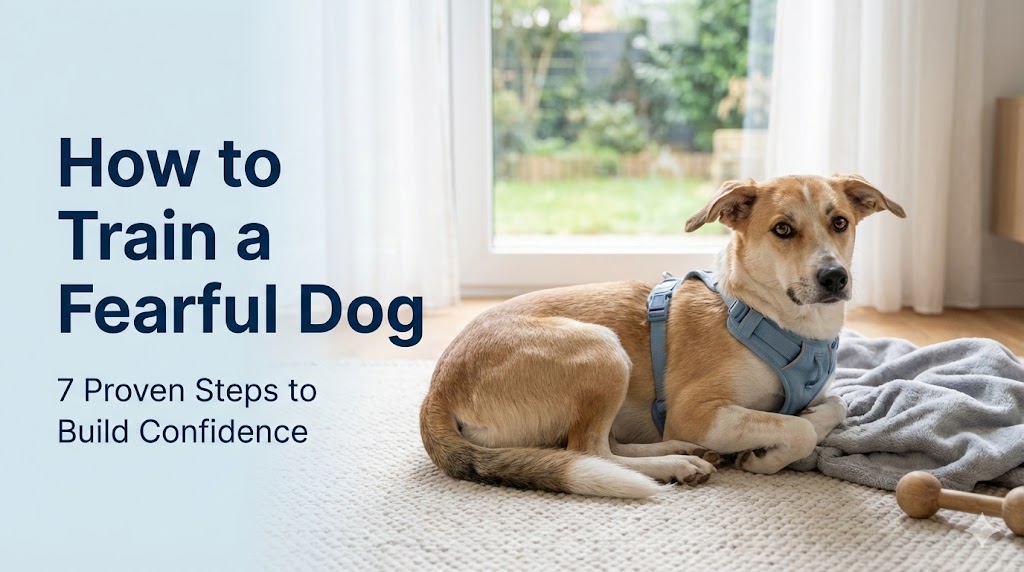
It may be like traversing a minefield when training a dog who is afraid. Your dog goes into fear mode at any startling noise, unknown person, or unfamiliar surroundings.
The problem is that scared dogs are not damaged. All they require is understanding, patience, and the proper strategy.
So, how do you train a fearful dog effectively? The answer lies in building trust gradually, celebrating small victories, and never forcing your dog beyond their comfort zone.
This thorough book will lead you through tried-and-true methods that truly work, regardless of whether your dog acquired concerns as a result of lack of socialization or came from a rescue shelter with a traumatic history.
You’re going to discover how to provide your terrified buddy the possibility to live a self-assured, contented existence.
Understanding Fear in Dogs
Fear is more than a peculiarity in conduct. It’s a normal emotional reaction that influences your dog’s worldview.
Consider this: will being forced into an elevator help you get over your fear of them? Not, of course.
Dogs might be afraid for a variety of reasons. Some people inherit their parents’ nervous dispositions. Some puppies miss important socialization windows, which occur between three and fourteen weeks of age.
Fearful reactions might be brought on by traumatic events, health problems, or even environmental changes. When learning how to educate a scared dog, it is helpful to comprehend these factors.
Recognizing Fear Signals
Your dog communicates fear through body language. Tucked tails, pinned-back ears, whale eyes (showing the whites), excessive panting, trembling, and attempting to hide or escape are all red flags.
Some dogs freeze completely.
Others become reactive, barking or lunging to create distance from whatever scares them.
Learning to read these signals is crucial.
Why? Because pushing a fearful dog past their threshold doesn’t build confidence—it creates trauma.
The Science Behind Fear-Based Training
Here’s where understanding canine psychology becomes your superpower. Dogs learn through associations.
When something scary happens, their brain creates a connection: “Thunder = danger” or “Strangers = threat.”
Traditional “dominance” training methods fail spectacularly with fearful dogs. Forcing them to “face their fears” or using punishment actually reinforces their anxiety.
You’re essentially confirming their worst suspicions—the world IS dangerous.
Positive reinforcement, on the other hand, rewrites these neural pathways. By pairing scary things with positive experiences, you gradually change how your dog’s brain processes fear triggers.
This isn’t just feel-good training philosophy—it’s neuroscience. Understanding how do you train a fearful dog through science makes all the difference. The key is knowing that fear responses can be modified through consistent, positive experiences.
Creating a Safe Foundation
Before you train anything, establish safety.
Your fearful dog needs a sanctuary—a quiet space where they can decompress without pressure.
Set up a comfortable crate or designated room with cozy bedding, white noise to muffle scary sounds, and puzzle toys for mental stimulation.
This becomes their safe zone, never used for punishment.
The Power of Routine
Predictability reduces anxiety.
Feed your dog at consistent times. Walk the same routes initially. Maintain regular sleep schedules.
When your dog can predict what happens next, their stress levels drop significantly.
This foundation is essential when learning how do you train a fearful dog successfully.
7 Essential Steps: How Do You Train a Fearful Dog
Step 1: Build Trust Through Patience
Trust doesn’t happen overnight.
Sit quietly near your dog without demanding interaction. Let them approach you.
Offer high-value treats (think chicken, cheese, or freeze-dried liver) without making direct eye contact, which dogs find threatening.
Some fearful dogs need weeks before they’ll take treats from your hand.
That’s okay. Progress isn’t linear.
Step 2: Master Desensitization
Desensitization means gradual exposure at intensities that don’t trigger fear.
If your dog fears the vacuum cleaner, start by placing it in the corner—turned off—while feeding dinner several feet away.
Over days or weeks, slowly decrease the distance.
Eventually, turn it on in another room while your dog eats.
The goal? Your dog barely notices because the exposure is so gradual.
Step 3: Implement Counter-Conditioning
This technique changes emotional responses.
Every time your dog encounters a fear trigger below their threshold, immediately deliver something amazing—treats, play, or whatever your dog values most.
Stranger appears across the street? Treat party!
Door slams? Jackpot treats!
You’re teaching their brain: “Scary thing predicts awesome things.”
Step 4: Use the “Look at That” Game
This brilliant technique gives your dog control. When they notice a trigger and look at you instead of reacting, reward generously.
You’re reinforcing calm awareness rather than fearful reactions.
Start at distances where your dog can see the trigger but remain calm. Gradually decrease distance as they master the game.
Step 5: Practice Confidence-Building Exercises
Simple tricks and nose work games build confidence through achievable successes.
Teaching “touch” (nose to hand), “find it” (scavenger hunts with treats), or basic obedience in low-stress environments creates positive momentum.
Each success releases dopamine, literally making your dog feel good about learning.
Step 6: Establish Clear Communication
Fearful dogs need predictable communication. Use the same verbal cues and hand signals consistently.
Reward approximations—if your dog attempts a behavior, reward the effort.
Avoid corrections or punishment. These backfire with anxious dogs, increasing fear rather than building skills.
Step 7: Know When to Retreat
Reading stress signals prevents setbacks.
If your dog shows fear responses, you’ve pushed too far.
Immediately increase distance from the trigger and return to the last successful level.
There’s no shame in taking steps backward.
In fact, it demonstrates excellent training judgment when you understand how do you train a fearful dog properly.
Training Techniques That Work
| Technique | Description | Best Used For | Timeline |
|---|---|---|---|
| Desensitization | Gradual exposure to triggers at sub-threshold levels | Specific phobias (sounds, objects) | 4-12 weeks |
| Counter-Conditioning | Pairing triggers with positive experiences | Changing emotional responses | 8-16 weeks |
| BAT (Behavior Adjustment Training) | Allowing dogs to control distance from triggers | Reactivity, social fears | 12-24 weeks |
| Target Training | Teaching dogs to touch objects or follow targets | Building focus and confidence | 2-6 weeks |
| Relaxation Protocol | Systematic practice of calmness in various situations | General anxiety | 6-10 weeks |
Common Mistakes to Avoid
Flooding—forcing prolonged exposure to fear triggers—is the biggest mistake owners make.
It doesn’t work. It traumatizes.
Reassuring a fearful dog with petting and “it’s okay” can actually reinforce fearful behavior.
Instead, stay calm and redirect to something positive.
Rushing progress because you’re impatient? That’s another training killer.
Fearful dogs need time. Lots of it.
When you’re figuring out how do you train a fearful dog, patience becomes your greatest asset.
The Role of Professional Help
Some fearful dogs need professional intervention.
Certified dog behavior consultants (CDBC) or veterinary behaviorists can assess complex cases and create customized protocols.
If your dog shows aggression born from fear, seeking professional help isn’t optional—it’s necessary.
The same applies if you’ve made no progress after several months of consistent training.
Don’t view this as failure.
Some fears run deep enough that professional expertise becomes essential.
Environmental Management Strategies
Sometimes the smartest training is avoiding triggers while you build skills. Can’t desensitize to fireworks today because New Year’s Eve is tonight?
Create a sound-proof den with white noise, drawn curtains, and calming music.
Use baby gates to control your dog’s exposure to household chaos. Arrange walking schedules to avoid peak neighbor activity.
Management buys you time to train properly.
Tools That Help
Thundershirts provide gentle pressure that calms many anxious dogs.
Adaptil diffusers release dog-appeasing pheromones.
Calming supplements containing L-theanine or chamomile may help (always consult your vet first).
These tools support training but don’t replace it.
Socialization Done Right
How do you train a fearful dog to accept new experiences? Very carefully.
Forget the myth that dogs need to “get over it” through forced socialization.
Instead, practice parallel exposure. Let your fearful dog observe other dogs playing from a comfortable distance. Reward calm observation.
Over time, cautiously decrease distance.
Never force interactions. Let your dog choose when and if to approach. Forced greetings often backfire spectacularly.
Exercise and Mental Stimulation
Physical exercise reduces overall anxiety levels.
But here’s the catch—some fearful dogs find walks terrifying.
Start with play in your backyard or hallway. Use flirt poles or indoor fetch.
Mental stimulation often tires dogs more effectively than physical exercise.
Food puzzles, snuffle mats, and training sessions engage their brains productively.
A tired, mentally satisfied dog handles stress better than an anxious, under-stimulated one.
Medication: When It’s Necessary
Training alone doesn’t always suffice.
Some dogs have anxiety so severe that medication becomes necessary to get them below threshold where learning can occur.
Anti-anxiety medications like fluoxetine or trazodone don’t “zombie” your dog—they provide a neurochemical foundation for behavioral modification.
Think of them like training wheels, not crutches.
Always consult a veterinary behaviorist for medication protocols.
Never use medication without concurrent behavior modification.
Measuring Progress
Progress with fearful dogs rarely moves in straight lines.
You’ll have amazing breakthroughs followed by frustrating setbacks.
That’s normal.
Keep a training journal.
Note what triggered fear responses and what worked well. Document distances, duration of exposure, and your dog’s reactions.
Over months, you’ll notice patterns.
That door that once sent your dog scrambling? Now they barely react.
These victories matter.
Frequently Asked Questions
How do I get my dog to stop being fearful?
Gradually expose your dog to fear triggers at a comfortable distance, rewarding calm behavior with treats and praise. Create positive associations through patience, consistency, and never forcing interactions. Consider professional help for severe cases.
Can a fearful dog be trained?
Yes, fearful dogs can be trained using positive reinforcement methods. Counter-conditioning and desensitization techniques help build confidence gradually. Progress takes time and patience, but most dogs can overcome fears with proper training and support.
What are 7 signs of stress in a dog?
Common stress signs include excessive panting, pacing, whining, trembling, ears pinned back, tail tucked, and yawning. Dogs may also show lip licking, dilated pupils, avoidance behaviors, or decreased appetite when anxious or uncomfortable.
What not to do with a fearful dog?
Never force your dog into scary situations, punish fearful behavior, or yell. Avoid flooding them with triggers, restraining during fear episodes, or comforting excessively which can reinforce anxiety. Don’t rush progress or ignore warning signs.
Are some breeds more prone to fearfulness?
Genetics play a role, but any breed can develop fear issues. Herding breeds sometimes show heightened sensitivity. However, individual temperament and early experiences matter more than breed.
Conclusion
Training a fearful dog isn’t quick or easy, but it’s profoundly rewarding. You’re not just teaching behaviors—you’re transforming a frightened animal’s entire world experience.
Every small victory, every moment when your dog chooses curiosity over fear, represents genuine progress.
Remember that how do you train a fearful dog ultimately comes down to patience, consistency, and compassion.
Your dog didn’t choose their fears, but with your help, they can learn that the world isn’t quite so terrifying after all.
Trust the process, celebrate the tiny wins, and never underestimate the power of your commitment.
The journey may be long, but watching your once-terrified companion blossom into a more confident version of themselves makes every patient moment worthwhile.
You’ve got this, and more importantly, your dog has you—and that makes all the difference.
External Resources
For additional support and evidence-based training techniques, visit the American Veterinary Society of Animal Behavior (AVSAB) at https://avsab.org/ or consult the Certification Council for Professional Dog Trainers (CCPDT) at https://www.ccpdt.org/ to find qualified professionals in your area.